
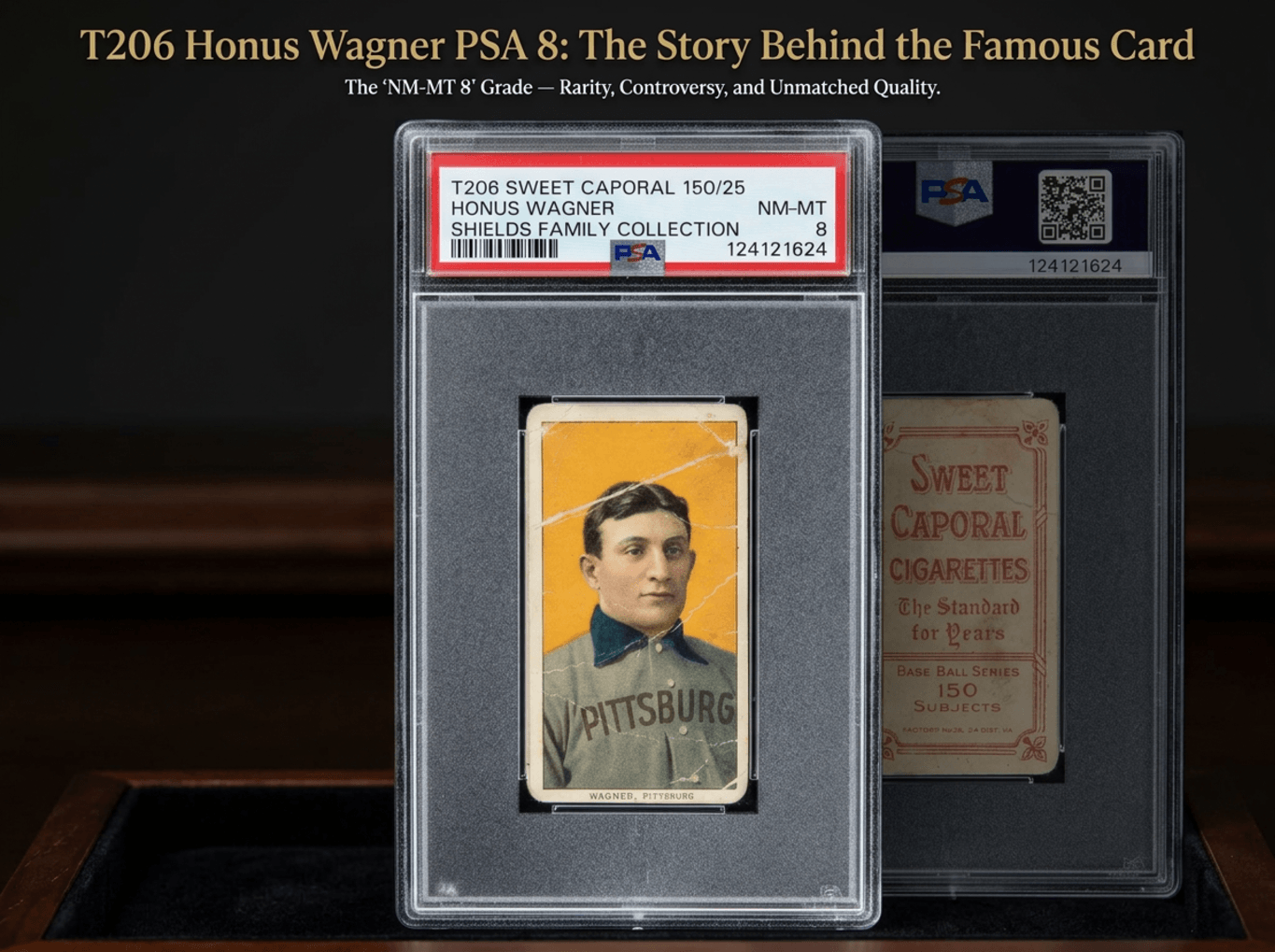
T206 Honus Wagner PSA 8: The Story Behind the Famous Card
Few cards are as closely connected to the history of professional card grading as the T206 Honus Wagner. But who thought that the most famous graded card would later become the subject of one of its biggest alteration controversies?
Even people who have never collected baseball cards have probably heard of the T206 Honus Wagner. It has appeared in documentaries, major auctions, and countless discussions about the most valuable collectibles in the world.
The American Tobacco Company issued this set from 1909 to 1911. Wagner’s card was pulled from production probably because he was against his image on the cigarette brand. Only fifty to sixty cards have been preserved. The collectors discuss the card just like car enthusiasts discuss the 1963 Ferrari 250 GTO, although, really, the Ferrari is more common.
However, one individual Wagner earned fame not because of its rarity.
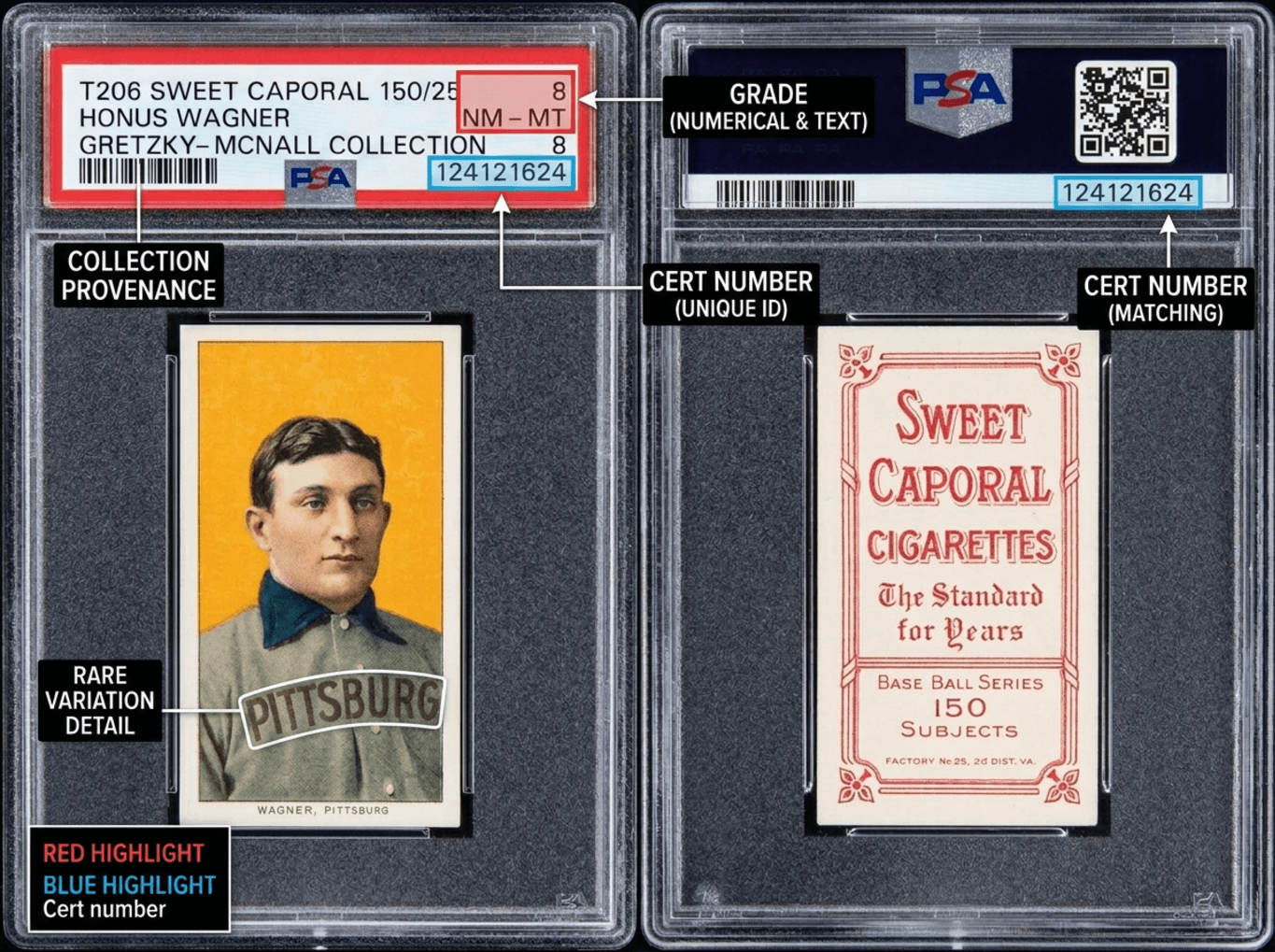
It earned a PSA 8 Near Mint-Mint rating at a time when professional card grading was still in its infancy. This is especially impressive for a card made almost 80 years ago. Wayne Gretzky and Bruce McNall were the owners of this card.
People started calling it the Gretzky Wagner. Big grade, legendary card, celebrity owner. You’d think that would be enough story for one piece of cardboard. It was nowhere near.
As it was later discovered, it had apparently been trimmed before being sent to the PSA. It was an authentic card,d no doubt about it. However, the claim was that some people had apparently used a paper cutter to fix the borders and make the card look better than it actually was.
They never mentioned that to the buyers, and this is what makes this card special. It is not about the scandal; honestly, it is more of a lesson collectors learned. Always remember a grade on a slab tells you one thing, but it doesn’t tell you everything.
Why the T206 Honus Wagner Is the Holy Grail of Sports Cards

A bit of context in order to understand the rest of the controversy.
The T206 cards are generally considered the beginning of sports card collecting. Wagner was a shortstop who played for the Pittsburgh Pirates, and he was immensely good. The card stopped being printed before the entire set was released.
Most folks believed that there was an issue with his endorsement of tobacco products. It is unknown what really happened, but the supply dried up.
There are probably only 50 or 60 of these cards remaining, and most of them look like they have been sitting in the bottom of a junk drawer for the last century.
And why is that? Because that is where they were sitting. So when one turned up looking clean and sharp, the hobby lost its mind.
The Card Before PSA
Of course, this card wasn’t accompanied by a tidy little provenance history all the way back to 1909. There rarely is for any old card back in the day.
This card came out of the woodwork in the mid-1980s at a memorabilia shop on Long Island, going for somewhere around $25,000, and was owned by a guy called Alan Ray. The Smithsonian cites Ray when discussing the card’s provenance history, but where Ray got the card is anybody’s guess.
Then a famous dealer, Bill Mastro, showed up. Bill and Rob Lifson, another famous dealer, purchased the Wagner card as part of an overall package of T206 cards at $25,000, then sold the Wagner to someone else for $110,000 in 1987.
That’s quite a markup. However, what Bill Mastro did with the card from the time of purchasing it until its subsequent sale was far more important than any markup.
People have been speculating about the card’s edges for decades now. The typical speculation: online forums at 2 a.m., card show hushed whispers, nobody ever having concrete proof. But then the feds showed up, and rumours turned into court documents.
According to the Department of Justice of the United States, Mastro confessed that he had cut the side borders of Wagner and did not disclose it during the sale of the card in 1987. Then again, he cut the card but kept it as another secret in 1992. Enough of speculation. Now it is a matter of the federal justice department, and his name is attached to it.
A PSA 8 on a Card From 1909
Before 1991, there was no such thing as professional card grading. You spent money on rare cards based on the looks of the item after examining it under the light and the dealer’s word alone. This is how the whole business was run.
However, PSA changed the game. The company put the card in plastic protection, labeled it with a condition grade, and gave the collectibles industry the one thing it needed – an objective grade of the card that could be argued.
Wagner got an 8, NM-MT. Very few of these T206 cards grade above a 1 or a 2 from that time period. A 3 is possible if it has been stored inside grandma’s Bible for 100 years. An 8 was almost unprecedented. It has slab number 00000001 and is referred to by many people as the first card ever PSA-graded. This might be a myth, but it doesn’t matter since this card became a landmark either way.
How Wayne Gretzky Made a Baseball Card Famous
Now the card went into the mainstream.
Our favorite card was auctioned at Sotheby’s in New York in March 1991. Gretzky and McNall, who owned the LA Kings, made the winning phone bid on it for $451,000, including buyer’s premium. According to the LA Times, this is the highest price paid for sports memorabilia.
Almost half a million dollars for a card in 1991! People who didn’t look at any card in their life had an opinion about this one.
Gretzky Wagner became a name attached to the card straight away, and went with the card through all its subsequent sales. Starting from 500 thousand dollars in 1995, going to 1.26 million dollars in 2000, then jumping to 2.8 million dollars by 2007.
People did not look at a sale of a T206 Wagner; there are more than enough of them around. People were watching the price of the particular card with a particular grade and with a particular history of sales grow amidst a story becoming only more complex year by year.
Trimming Allegations That Shook the Hobby
So, trimming is basically cutting off the edges or little bits of the card’s borders with a knife or blade. The edges become sharper, and the process of centering gets better. However, the size of the card changes forever, and no one grades trimmed cards anymore.
With a T206 Wagner, the temptation is obvious.
A battered old one will sell for hundreds of thousands, while a crisp one sells for millions. And that is the entire reason for doing what people do.
Doubts about the edge quality of this Wagner lingered for many years until 2013.
Mastro pleaded guilty in a federal case involving mail fraud. As part of his guilty plea agreement, Mastro confessed under oath that he trimmed the side borders of the well-known Wagner using a machine designed to slice paper in the 1980s.
He didn’t even bother to tell one of his customers. Prosecutors added that Mastro repeated the process in 1992 and didn’t say anything then either.
The most well-known card in the hobby had been tampered with before PSA ever graded it.
Altered vs. Counterfeit: Why the Distinction is Important
People mix these two up all the time, and it changes the whole meaning of the story when they do. A counterfeit is a fake. Someone printed the card in order to make it appear to be a real card. An altered card is authentic, but some person tampered with the card after it was produced.
Trimmed its borders, touched up a worn-out corner, restored the card. The card is authentic. It just received the makeover that it never wanted to receive.
No one manufactured a fake Wagner card and sent it to PSA to pass as an authentic one. Mastro trimmed the borders of an authentic card without informing anybody. Saying that a card was a “fake Wagner” card means telling a story that never took place.
Authentication relates to the legitimacy of the card. Alteration checks the card for any modifications done to it. Meanwhile, grading involves the score that the organization assigns to the card.
Three different issues. Answering one question does not mean answering two others.
And when all three land on the same card, the individual story behind that specific slab starts mattering way more than just the number on the front.
How the Wagner Controversy Impacted The Hobby
The Wagner did not break collectors’ faith in grading. In fact, it spurred the industry to improve itself. PSA, BGS, and SGC all invested more heavily in catching trimmed cards before they ever received a number grade
Following the Mastro incident, grading companies have refined their procedures. Detection of alterations has become an even more important task for authentication specialists. What could have passed as genuine in 1991 would stand little chance of surviving today’s scrutiny.
Collectors were affected as well. Instead of relying on the rating of a given card, the source of it became important to buyers. Research of population statistics, sales records, and certification reports is now routine work before any purchases.
Your Card's Best Line of Defense is the Cert Number
That is where the Wagner card stops being just one notable example and becomes your own story.
There can be two slabs of the same grade and completely different identities, separated by the cert number on their labels. The grade will tell the condition of the card. The cert number will tell what specific slab you’re holding. One is the model and make. The other is the VIN.
And that makes a huge difference when something goes wrong. A stolen graded card is not sitting in someone’s storage and waiting for it to be discovered. It travels across state borders and pops up in some card shop, some convention during the weekend, or even in some online offer made by an account opened right before that. But as long as nobody cracks the card out of its case, the cert number on the slab stays the same.
That’s where Kapture can help card collectors. You see the platform holds the searchable registry of all stolen graded cards sorted by cert numbers. You record your numbers and in case of any theft, you register the cert number in the registry. And then it takes just a few seconds.
Whenever that card appears in some other place, whether it’s in the shop or on the Internet, a buyer can always verify the number on the card to know if there are any flags or its a stolen one.
But if someone cracks the card out of its holder, the link between the card and that cert record breaks. But while the slab stays sealed, the number works like a booby trap.
Collectors followed the Gretzky Wagner for decades not simply because it was a T206 Honus Wagner. There were plenty of those. They followed it because of its history, its conspiracy, a history unique among all the other Honus Wagners ever made.
A grade might be the first number your eyes go to on a slab. The cert number might turn out to be the more important one.